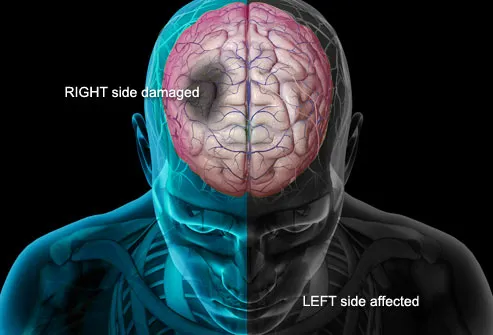
A stroke is a medical emergency and Prompt Treatment is crucial. Early action can minimize brain damage and potential complications.
Strokes secondary to cardiogenic embolism are caused by emboli (moving blood clots) that develop in the heart. The embolus travels through the bloodstream and becomes stuck in a small artery in the brain.
Because stroke injures the brain, you may not realize that you are having a stroke. To a bystander, someone having a stroke may just look unaware or confused. Stroke victims have the best chance if someone around them recognizes the symptoms and acts quickly.
Act FAST
- Facial Weakness

- Arm & Leg Weakness
- Speech Problems
- Time is Critical
If you answer yes to any of the above CALL AN AMBULANCE IMMEDIATELY!
Stroke prevention continues to be a sought after topic in our society.
Although stroke is considered a disease of the brain, it can affect the entire body. The effects of a stroke range from mild to severe and can include paralysis, problems with thinking, problems with speaking, and emotional problems. Patients may also experience pain or numbness after a stroke.
The way to prevent any disease process in the body is to first understand the mechanisms by which the process begins. The breaking away of plaque built up on the blood vessel walls that produce blood clots are the primary causes for strokes.
The good news is that strokes can be treated and prevented, and fewer people now die of stroke than was the case even 15 years ago due to more awareness to risk factors such as high blood pressure and smoking.
- A Brain cell function requires a constant delivery of oxygen and glucose from the bloodstream.
- A stroke, or cerebrovascular accident (CVA), occurs when blood supply to part of the brain is disrupted.
- After a stroke, the part of the brain that is supplied by the clotted blood vessel is then deprived of blood and oxygen. As a result of the deprived blood and oxygen, the cells of that part of the brain die or become damaged, and the part of the body that it (the Neurons) control, stops working or damaged to some degree.
- Patients may often suffer physical disabilities such as partial loss of motricity or hemiplegia, sensory loss, language disorders, aphasia, visual disorders, and even memory loss.
- Level of recovery will vary from patient to patient. Starting rapidly a rehabilitation program is key to recovery.
Stroke commonly affects the emotions. It can cause lack of control of your emotions and an improper response may happen at inappropriate times. This is called the pseudobulbar affect (PBA), also known as emotional lability, is a distinct neurologic disorder that causes sudden and unpredictable episodes of crying, laughing, or other emotional displays.
Stroke has a new indicator
If you pass this information on to some of your friends, you stand a chance of saving one life.

Blood Clots/Stroke – They Now Have a Fourth Indicator,

the Tongue
STROKE Remember the 1st Three Letters….S. T. R.
STROKE IDENTIFICATION:
During a BBQ, a woman stumbled and took a little fall – she assured everyone that she was fine (they offered to call paramedics) …she said she had just tripped over a brick because of her new shoes.
They got her cleaned up and got her a new plate of food. While she appeared a bit shaken up, Jane went about enjoying herself the rest of the evening.
Jane’s husband called later telling everyone that his wife had been taken to the hospital – (at 6:00 PM Jane passed away.) She had suffered a stroke at the BBQ. Had they known how to identify the signs of a stroke, perhaps Jane would be with us today. Some don’t die. They end up in a helpless, hopeless condition instead.
It only takes a minute to read this.
 A neurologist says that if he can get to a stroke victim within 3 hours he can totally reverse the effects of a stroke…totally. He said the trick was getting a stroke recognized, diagnosed, and then getting the patient medically cared for within 3 hours, which is tough.
RECOGNIZING A STROKE
Thank God for the sense to remember the ‘3’ steps,
S . T . R
Read and Learn!
Sometimes symptoms of a stroke are difficult to identify. Unfortunately, the lack of awareness spells disaster. The stroke victim may suffer severe brain damage when people nearby fail to recognize the symptoms of a stroke.
Now doctors say a by-stander can recognize a stroke by asking three simple questions:
S *Ask the individual to SMILE.
T *Ask the person to TALK and SPEAK A
SIMPLE SENTENCE (Coherently)
(I.e. It is sunny out today.)
R *Ask him or her to RAISE BOTH ARMS.
If he or she has trouble with ANY ONE of these tasks, call emergency number immediately and describe the symptoms to the dispatcher.
New Sign of a Stroke ——– Stick out Your Tongue
 NOTE: Another ‘sign’ of a stroke is this: Ask the person to ‘stick’ out his tongue. If the tongue is ‘crooked’, if it goes to one side or the other that is also an indication of a stroke.
The length of time between the first warning signs and the time you get to a hospital may be the difference between a good or poor outcome. Patients who present to the hospital within 3 hours of the first sign of a stroke have the possibility to receive Tissue Plasminogen Activator
There are two main types of stroke:
- Ischemic strokes or cerebral infarcts(80% of strokes) result from a blockage or a reduction of blood flow in an artery that irrigates the brain. Causes can be either by a blood clot (thrombus) which blocks the blood vessel or by the buildup of plaque within the arteries which narrows vessels resulting in a loss of blood flow

- Haemorrhagic strokes are due to the rupture of an artery within the brain which can trigger an : intracerebral haemorrhage (15% of strokes) or to the rupture of an aneurysm (arteriovenous malformation) entailing subarachnoid haemorrhage (5% of strokes)
Narrowing of the small arteries within the brain can cause a lacunar stroke, (lacune means “empty space”). which is a blockage of a single arteriole, and can affect a tiny area of brain causing that tissue to die (infarct).
Hardening of the arteries (atherosclerosis) leading to the brain. There are four major blood vessels that supply the brain with blood.
- The anterior circulation of the brain that controls most motor activity, sensation, thought, speech, and emotion is supplied by the carotid arteries.
- The posterior circulation, which supplies the brain stem and the cerebellum, controlling the automatic parts of brain function and coordination, is supplied by the vertebrobasilar arteries.
If these arteries become narrow as a result of atherosclerosis, plaque debris can break off and float downstream, clogging the blood supply to a part of the brain. As opposed to lacunar strokes, larger parts of the brain can lose blood supply, and this may produce more symptoms than a lacunar stroke.
The symptoms of stroke are distinct because they happen quickly:
• Sudden numbness or weakness of the face, arm, or leg (especially on one side of the body)
• Sudden confusion, trouble speaking or understanding speech
• Sudden trouble seeing in one or both eyes
• Sudden trouble walking, dizziness, loss of balance or coordination
• Sudden severe headache with no known cause
If you, or a close friend or relative has experienced a stroke (preferably recently) and have been unfortunate enough to be suffering from the after affects of the stroke, please do not hesitate to contact us at Sirius Health, the earlier the better, our method of healing also extends overseas.